
 DE
DE EN
EN IT
IT SL
SL HU
HU SK
SK CS
CSDouble XXL loading tables: Double-deck semi-trailer completely unloaded
Hydraulic loading table in special design with assembly by maluk.
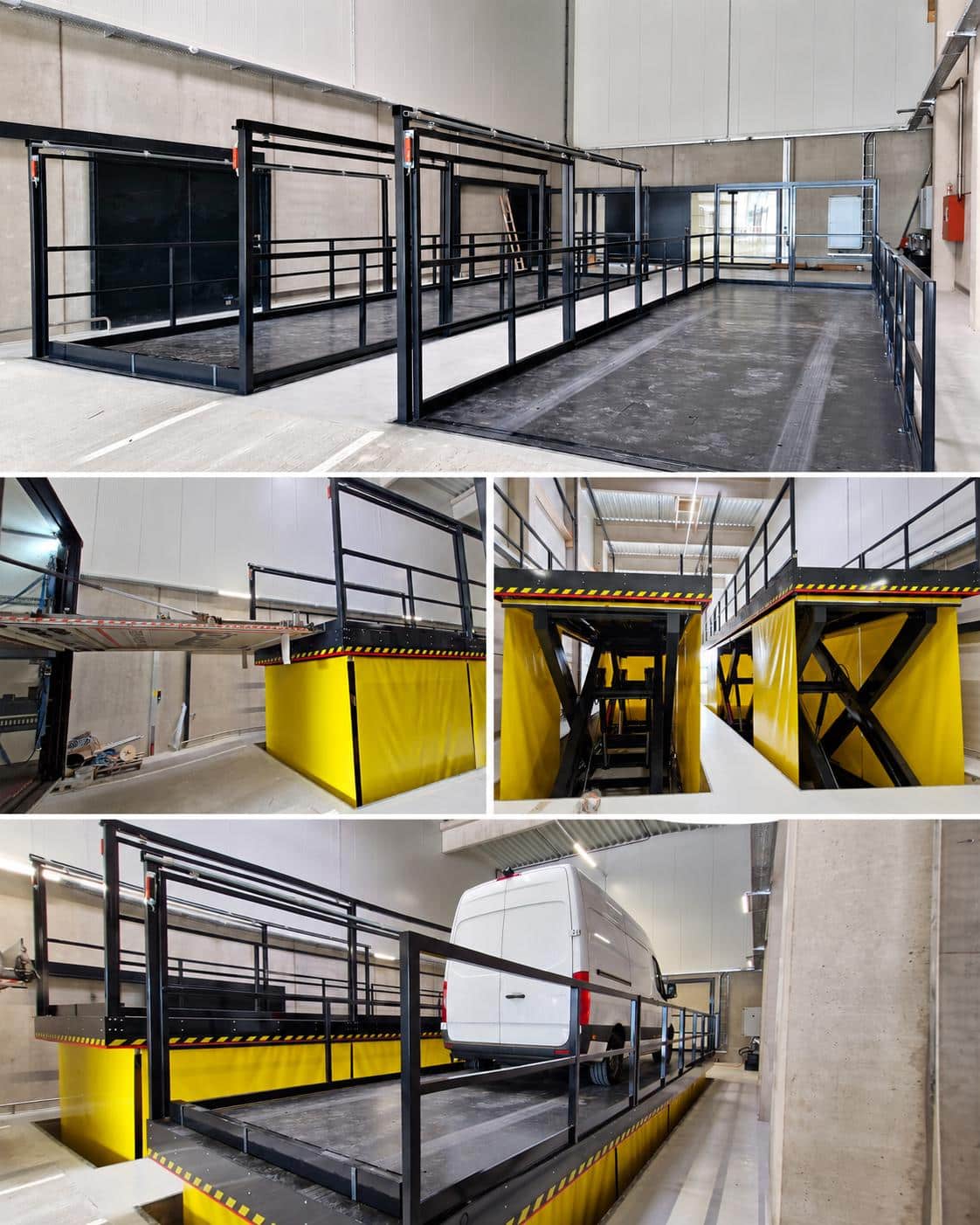
With this project for an industrial company in Styria, the goal wasn’t simply to compensate for a height difference at the loading ramp. The task was significantly more demanding: Double-deck semi-trailers should be able to be loaded and unloaded directly in the goods receiving area – both on the lower and upper loading level.
In addition, there was a second requirement that was crucial for the subsequent workflow: the platform should be large enough that unloading does not end after just a few pallets.
The solution is two massive loading tables, each with 12 meters platform length, 3.10 meters width and 16 tons of carrying capacity.
The special feature: The load of a forklift can be collected on the long platform without having to remove any goods from the lift table after half the load has been unloaded. This saves time spent in transit and unnecessary lifting cycles.
And even more importantly: Through the 3,500 mm of usable length The lifting tables can be moved to different loading heights. This also allows for the upper level of a double-decker carousel reach.
Double-deck semi-trailers pose special requirements
A classic loading ramp is designed for a specific loading height. With normal trucks and semi-trailers, this works without problems.
With a double-deck trailer, things are different. Here, two distinctly different loading levels must be reached. That is exactly what the system is designed for.
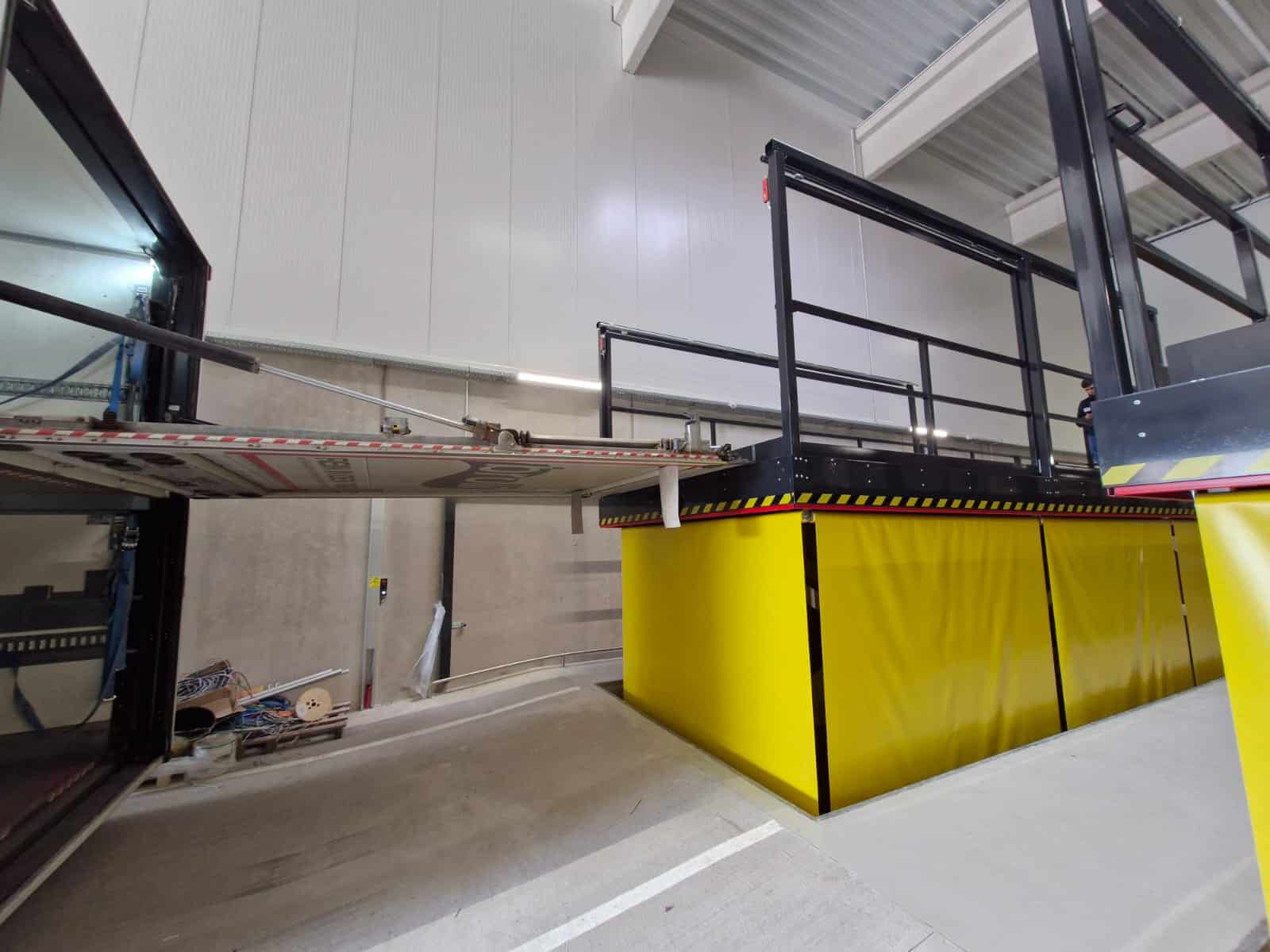
The truck docks at the loading bay and the lifting table is moved to the required height. This not only allows the lower loading level to be operated. The lifting table also moves upward to the point where the second, upper loading level of the double-deck platform can be reached and unloaded directly.
This makes the solution particularly interesting for companies that regularly use double-decker vehicles for incoming goods.
load
16,000 kg
Platform
16,000 x 3,100 mm
Hub
3500 mm
The crucial difference: 12 meters platform length
Many loading platforms are two or three meters long. For the classic height adjustment between truck and ramp, this is more than enough.
However, with this project we wanted to take a different approach.
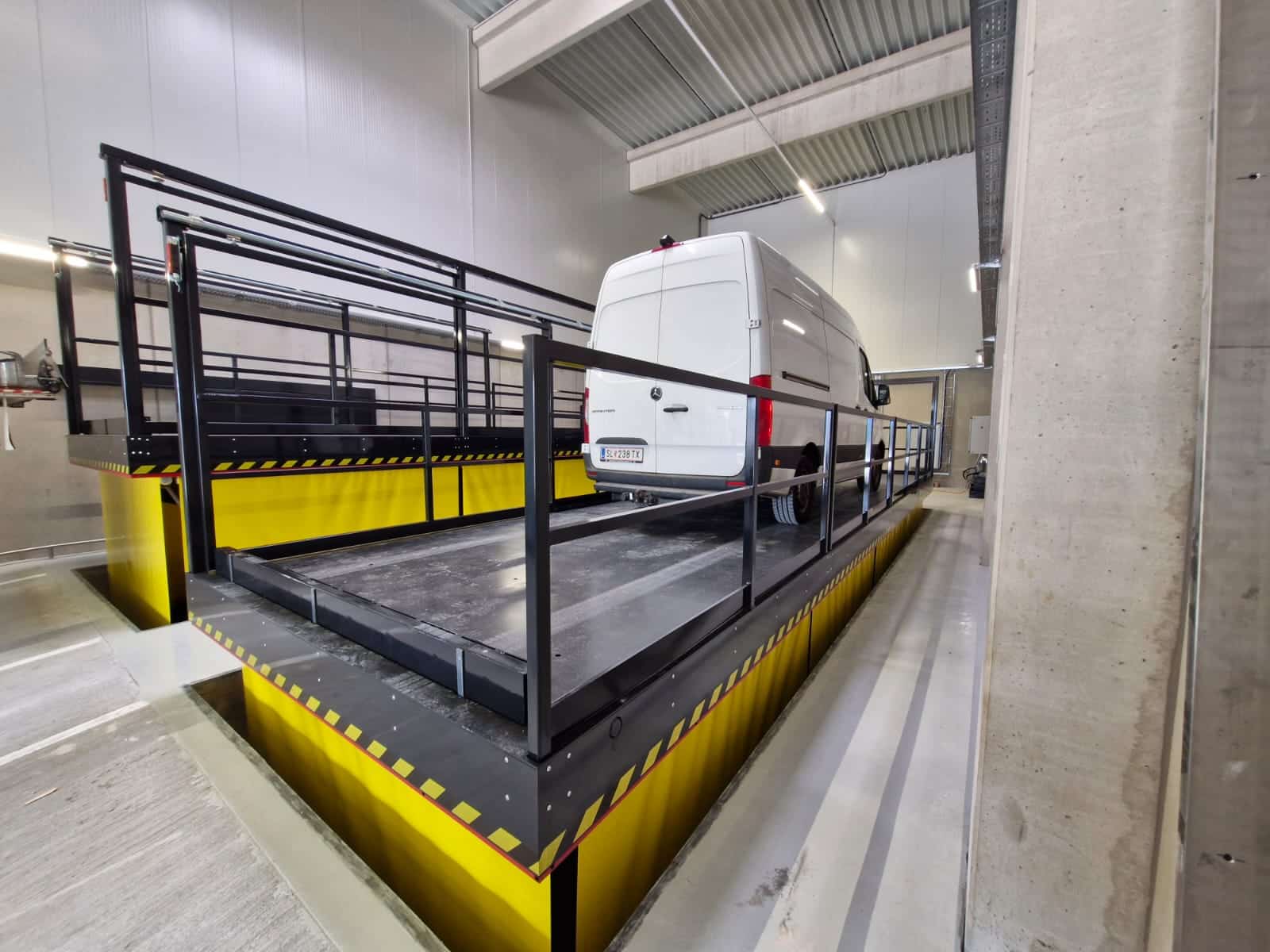
Each of the two lifting tables has a platform of 12,000 × 3,100 mm. This means that an exceptionally large area is available for the handling of goods.
Why is this so important?
For example, if the platform were only six meters long, part of the load would have to be transported to the lifting table, then brought to the hall level and transported back there. After that, the lifting table would have to drive back to the truck to pick up the next part.
With a platform length of twelve meters, this additional intermediate step is exactly what is missing.
The cargo can initially be collected on the large lifting table platform. Only then is the platform transported to the required hall level and unloaded.
Especially with many pallets, roll containers or transport carts, this difference becomes noticeable in daily operation: fewer interruptions, fewer lifting movements and a significantly more linear flow of material.
Important to note: The tractor itself is not lifted.. The 12-meter-long platform is designed to receive the goods discharged from the vehicle.
They can also reach the upper level of the double-decker truck.
The second major advantage of this system is the unusually large stroke length.
With a Profit increase of 3,500 mm Different vehicle and loading heights can be accommodated. This is exactly what is required for double-deck trailers.
The operator positions the platform at the required height. This allows the lower loading level to be accessed first, or depending on the situation, the upper loading level can be accessed next. The loading lift then moves to the height of the upper loading bay.
This transforms a fixed loading ramp into a much more flexible loading station.
For the customer, this means: The same system serves different loading heights and enables the discharge of both levels of a double-deck freight elevator.
This very point was crucial in the planning process and sets the two systems apart from a conventional loading lift table.
Safety at 12 meters platform and 16 tons of lifting capacity
With a platform of this size, it’s obviously not enough to simply place a large scissor lift table in a pit.
Handrails, access points, gate systems and underpass protection were therefore planned together with the installation situation from the very beginning.
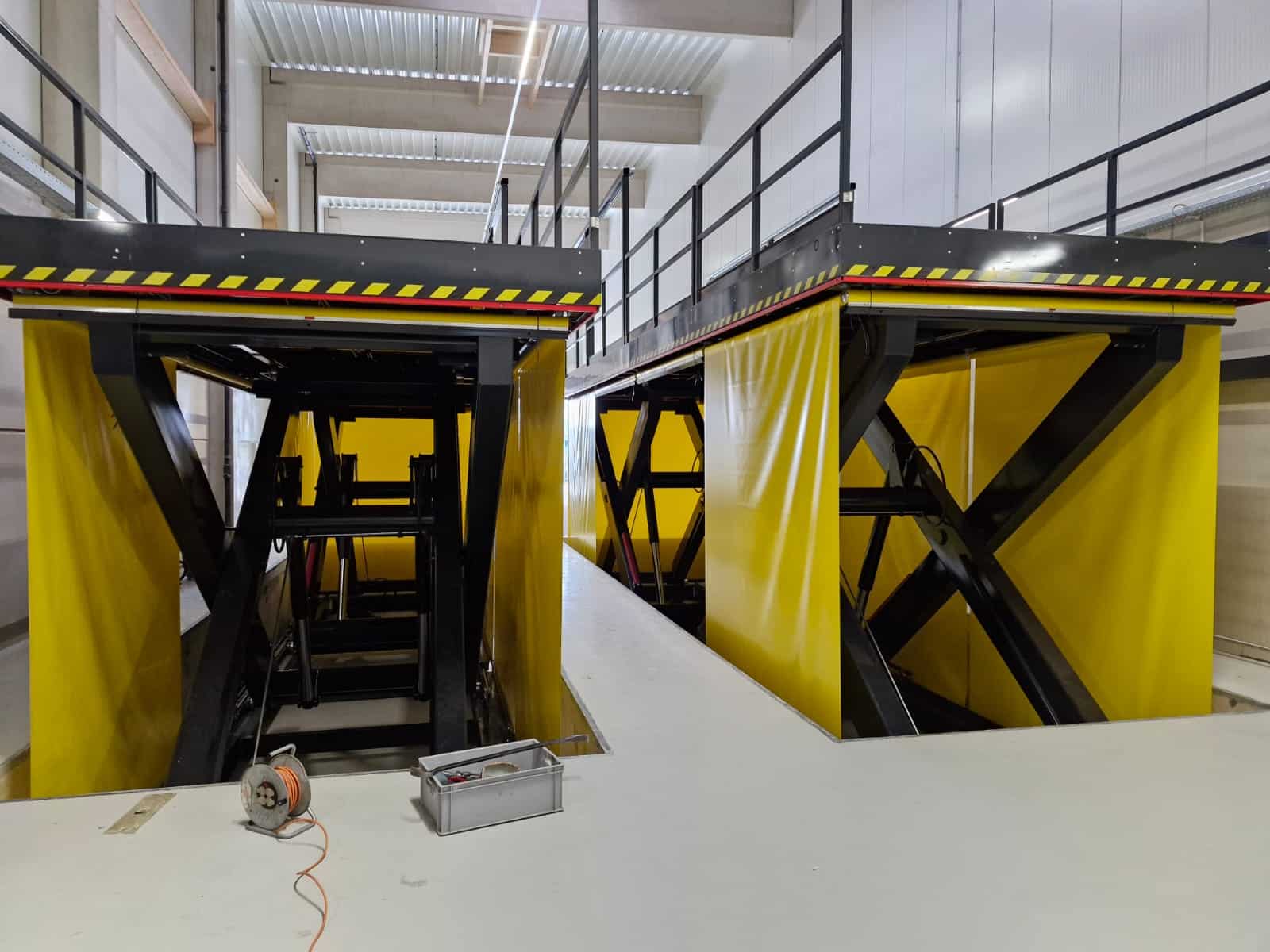
Below the platform is an all-round yellow PVC underlay protection. It separates the area of the shearing construction from the normal working area.
The platform features protective railings and monitored gate systems to ensure that the intended access points are clearly defined.
A special feature is also the hydraulic anti-roll bar. It prevents transport carts or other rolling loads from unintentionally rolling off the platform.
The roll-over protection is activated at the touch of a button and is integrated into the control system: The lifting table can only lift or lower when the safety device is in the intended position.
In addition, the system features maintenance supports, an overpressure valve, a check valve, end position monitoring, and monitored access points.
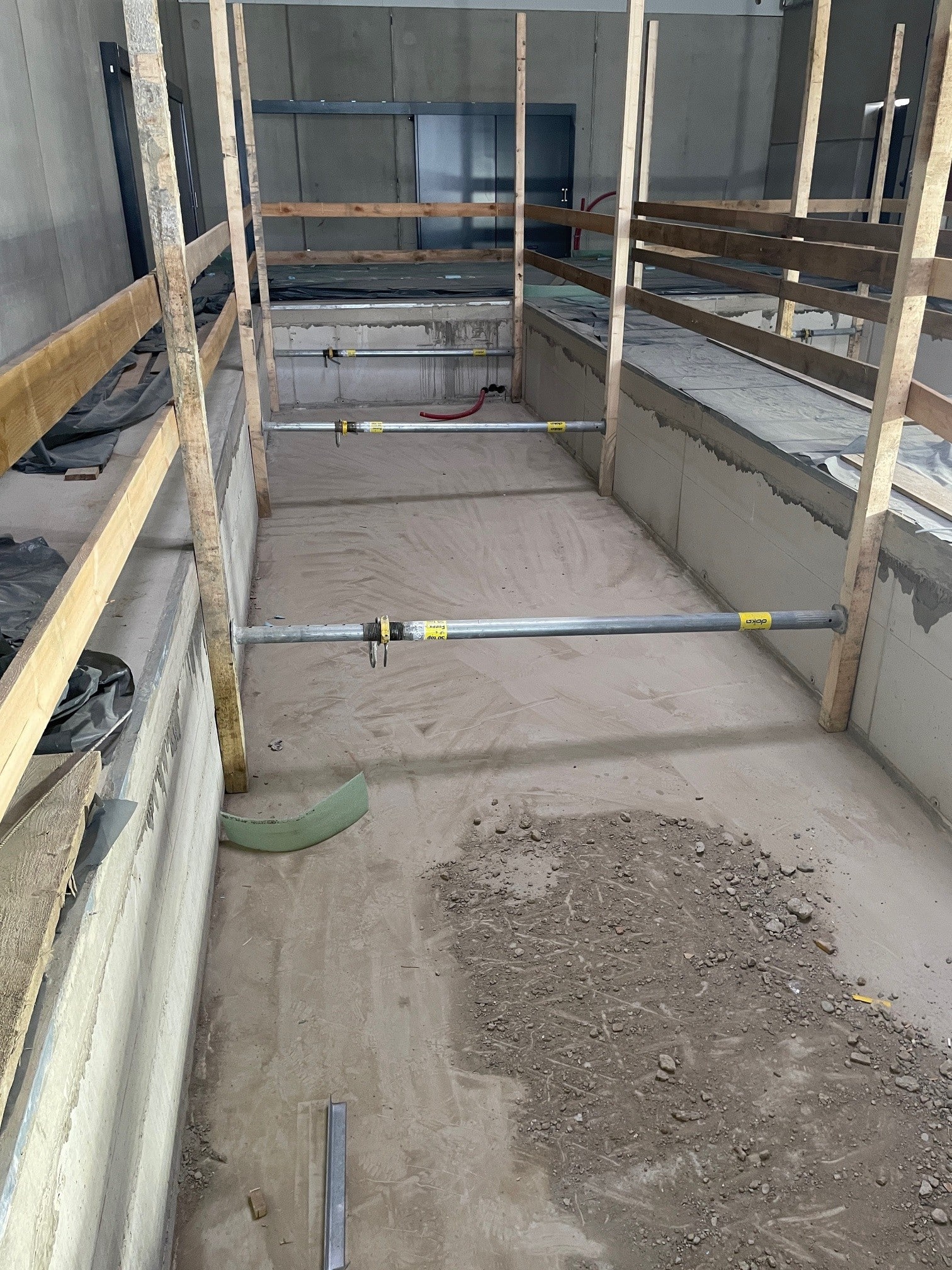
From the empty pit to the finished loading station
The image of the prepared concrete pit shows well how early a project of this magnitude must be coordinated.
With a platform length of twelve meters and a payload of 16 tons, the pit, access routes, piping, safety areas, gate positions, and location of the hydraulic system must all be compatible before assembly can begin.
After the construction work was completed, both systems were installed, assembled, hydraulically and electrically connected, and put into operation.
To conclude, the trial operation takes place, including the onboarding of the operating staff. Especially in the case of such a large loading facility, it is important that not only the technology works, but that the subsequent workflows are also clear.
XXL loading lift instead of a compromise solution
With special systems, it is often only during daily operation that it becomes clear whether the entire process was really considered when planning.
With this project, two smaller platforms could also have been used. Technically, this would have been possible. However, in operation, this would have meant additional lifting operations and more goods movements.
Therefore, the loading lifting tables were deliberately designed to be 12 meters long and 16 tons of carrying capacity designed.
The result is a loading solution that solves two problems at the same time: Large truck loads can be handled without unnecessary space between them, and double-deck semi-trailers can also be operated on their upper loading level.
We do not develop loading and unloading tables to standard dimensions for such applications; instead, we tailor them to the vehicle, building, and actual material flow.
Video of the XXL loading lift table
You are currently viewing a placeholder content from YouTube. To access the actual content, click the button below. Please note that doing so will share data with third-party providers.
More InformationLoading challenge?
If you have any questions, please contact us immediately. We are happy to help!
FAQ about loading platforms for double-deck trucks
Frequently asked questions about truck loading
Yes. What is crucial is that the lift height, platform size, load capacity and the structural conditions of the double-deck trailer are coordinated. In this project, the useful lift height is 3,500 mm, allowing both the lower and upper loading levels to be reached.
The large platform reduces intermediate operations during unloading. Instead of moving the lifting table to retrieve part of the load and temporarily transporting the goods, a 12,000 × 3,100 mm area is available. This allows significantly more goods to be loaded in one operation.
Each of the two lifting tables in this project is designed for one distributed load of up to 16,000 kg Designed. The carrying capacity and load distribution must be dimensioned for each project appropriately to the goods and transport means actually used.
This system includes, among other things, PVC underrun protection, guardrails, monitored gate systems, a hydraulic anti-roll protection system, maintenance supports, an overpressure valve, and monitored end positions. The required equipment depends on the specific installation situation. Underrun protection, anti-roll protections, guardrails, and gates are also typical project-specific safety solutions for other industrial loading dock systems.
In systems of this size, this is practically always the case. Platform length and width, travel distance, lifting capacity, access sides, gate positions, hydraulics, pit, and safety equipment must be considered together. Especially for double-deck hoists, the coordination of the actual loading heights is particularly important.