
 DE
DE EN
EN IT
IT SL
SL HU
HU SK
SK CS
CSHeavy duty lifting table for Saudi Arabia: 20 tons in just 6 weeks
Specialized hydraulic heavy-duty lifting table from maluk
20 tons of lifting capacity, an eight-ton heavy machine that moves on the platform in two directions. One Delivery time of just six weeks. This project had something special about it.
An industrial testing facility in Saudi Arabia required a heavy-duty lifting table that could lift much more than just heavy loads. The task was to lift a test object weighing approximately 8,000 kg to various working heights and align it there with millimeter precision.
The special feature: The heavy installation is not only lifted, but also moved in the X and Y directions on the lifting table platform. And this even when the lifting table is lifted.
In addition, there was the issue of the installation position, the need to integrate it into a customer-side control system, and special requirements regarding safety. For our technicians, this quickly became clear: what is needed here is a custom-made heavy-duty scissor lift table.
Prepared for Saudi Arabia
For an installation for international use, the conditions at the later location must also be taken into account.
These include in particular the existing power supply, the network frequency and the environmental influences. For the project, specifications with 400 V/50 Hz and 460 V/60 Hz were considered. The actual required configuration depends on the electrical conditions at the installation site.
Possible high ambient temperatures and dust loads must also be taken into account when planning and subsequently installing the system.
And then there was the schedule: Only six weeks were available for the production of this individually designed 20-ton lifting table..
Thanks to express production, this exceptionally short production time was achieved.
load
20,000 kg
Platform
3,700 x 2,500 mm
Hub
1000 mm
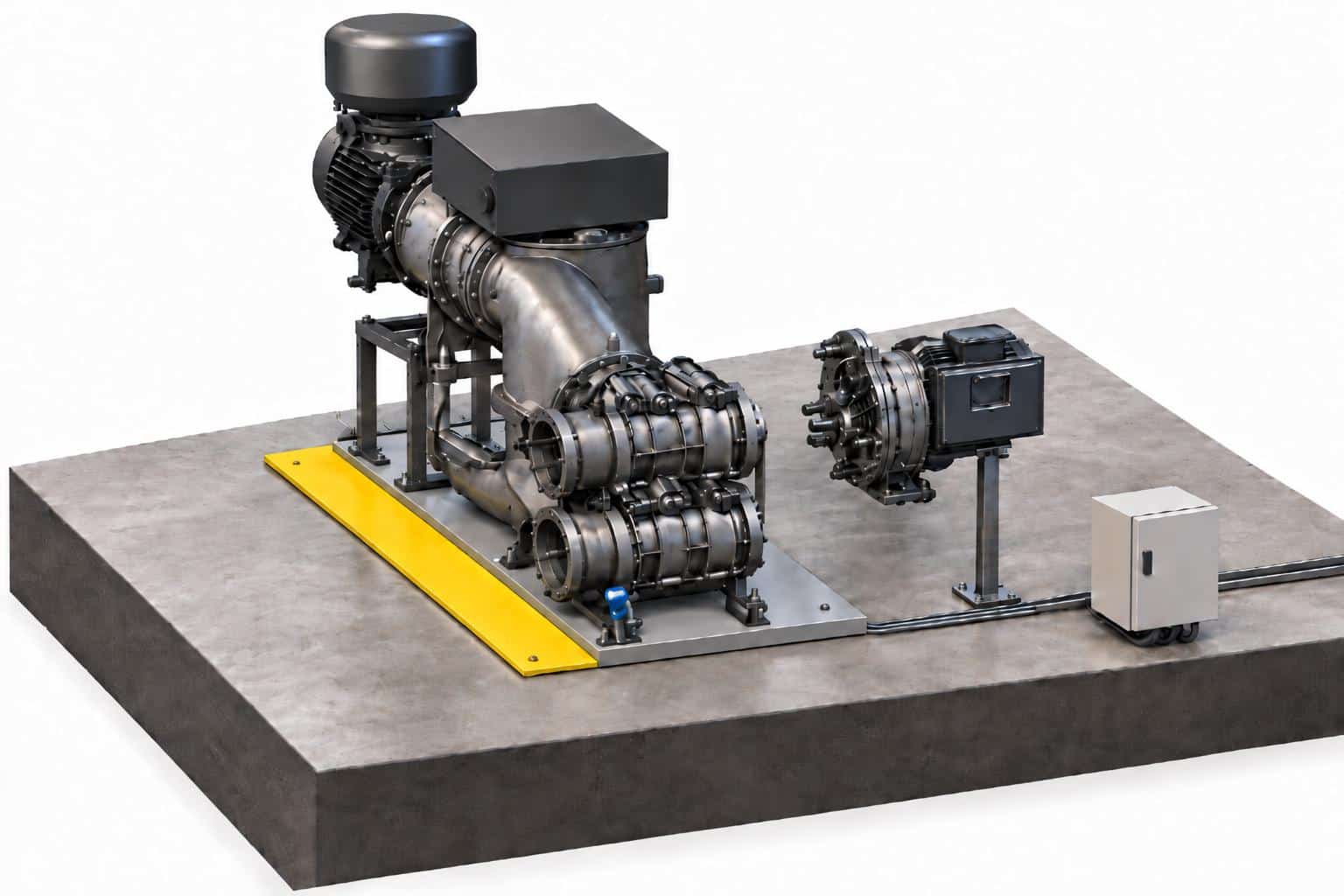
20 tons of lifting capacity – and 8 tons are moving on the platform
Lifting an 8,000 kg heavy test object is, in principle, not an extraordinary task for a heavy-duty lifting table with corresponding dimensions. It becomes more difficult when this load is also required to move horizontally on the lifted platform.
That was exactly what was required for this project.
The customer installs its own rail system on the 3,700 × 2,500 mm platform. This allows them to move the test object in two directions and position it exactly in front of an adjacent test device.
The system is connected electrically to the testing device at two different heights. Subsequently, it remains in the respective testing position for up to 30 minutes while electrical tests are performed.
The particular challenge lies in the combination of 20,000 kg of nominal load capacity and a 8,000 kg heavy, horizontally movable load. Therefore, the structural design must take into account not only the total weight, but also the varying load distribution and the forces generated by the process.
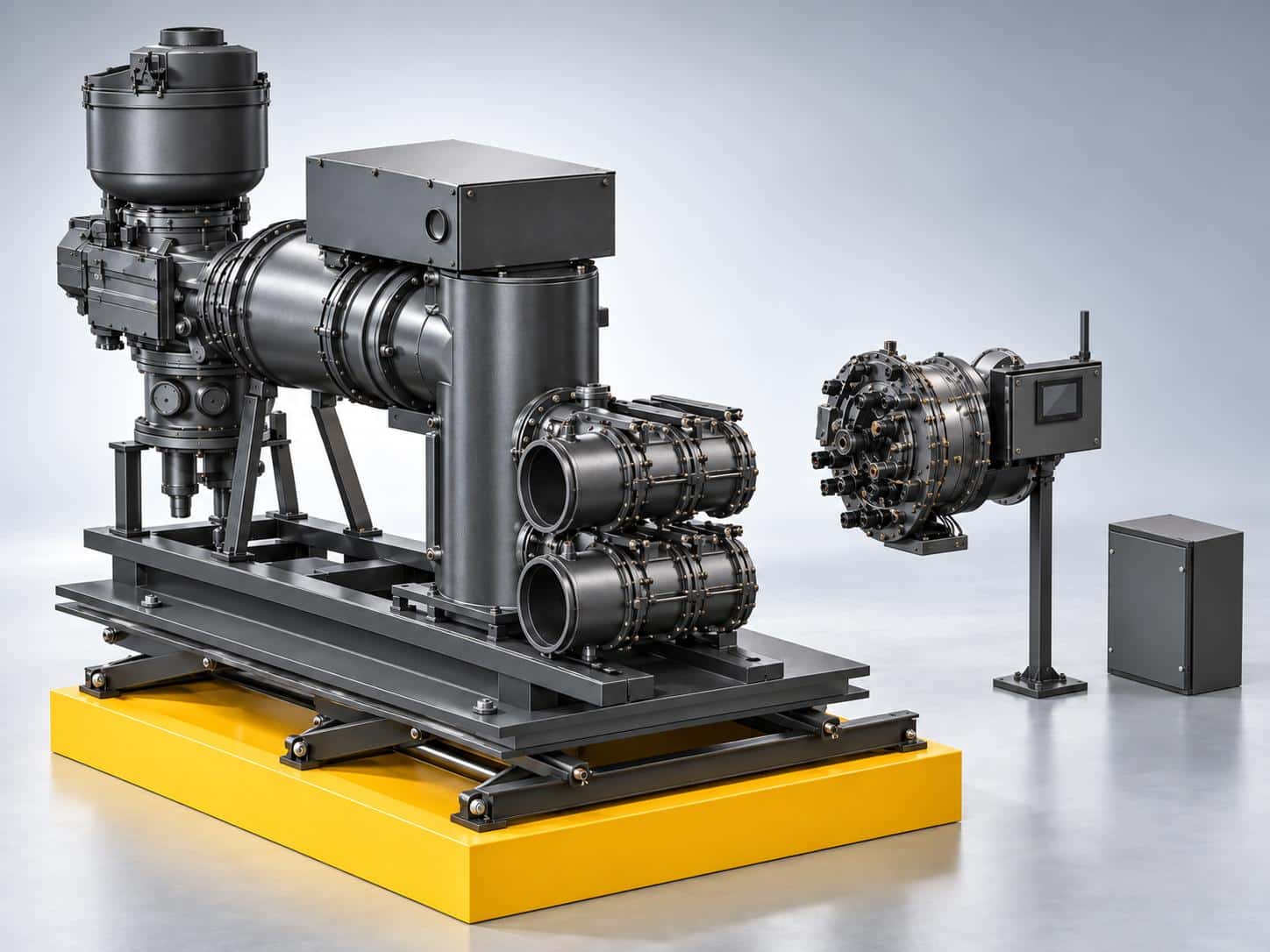
Millimeter-precise positioning despite enormous strain
With many lifting tables, it is sufficient to reliably engage the upper or lower end position. Here, the system had to work much more precisely.
The required The positioning accuracy of the entire system is ± 3 mm.
To enable this, the heavy-duty lifting table was prepared for integration with a customer-side path measuring system and frequency converter. The electric motor is designed to comply with FU standards. Additionally, mounting options for a cable pull sensor have been provided.
The platform itself was also designed to accommodate later installation integration. The drilling and threaded connections allow the customer-side rail system to be installed.
Another important detail concerns the lower stop. Adjustable mounting bolts are used here. This allows the lower fixing position to be adjusted mechanically within the range of 0 to +50 mm.
Thus, the customer not only receives a powerful lifting table, but also the mechanical and electrical requirements for precise positioning within its own testing machine.
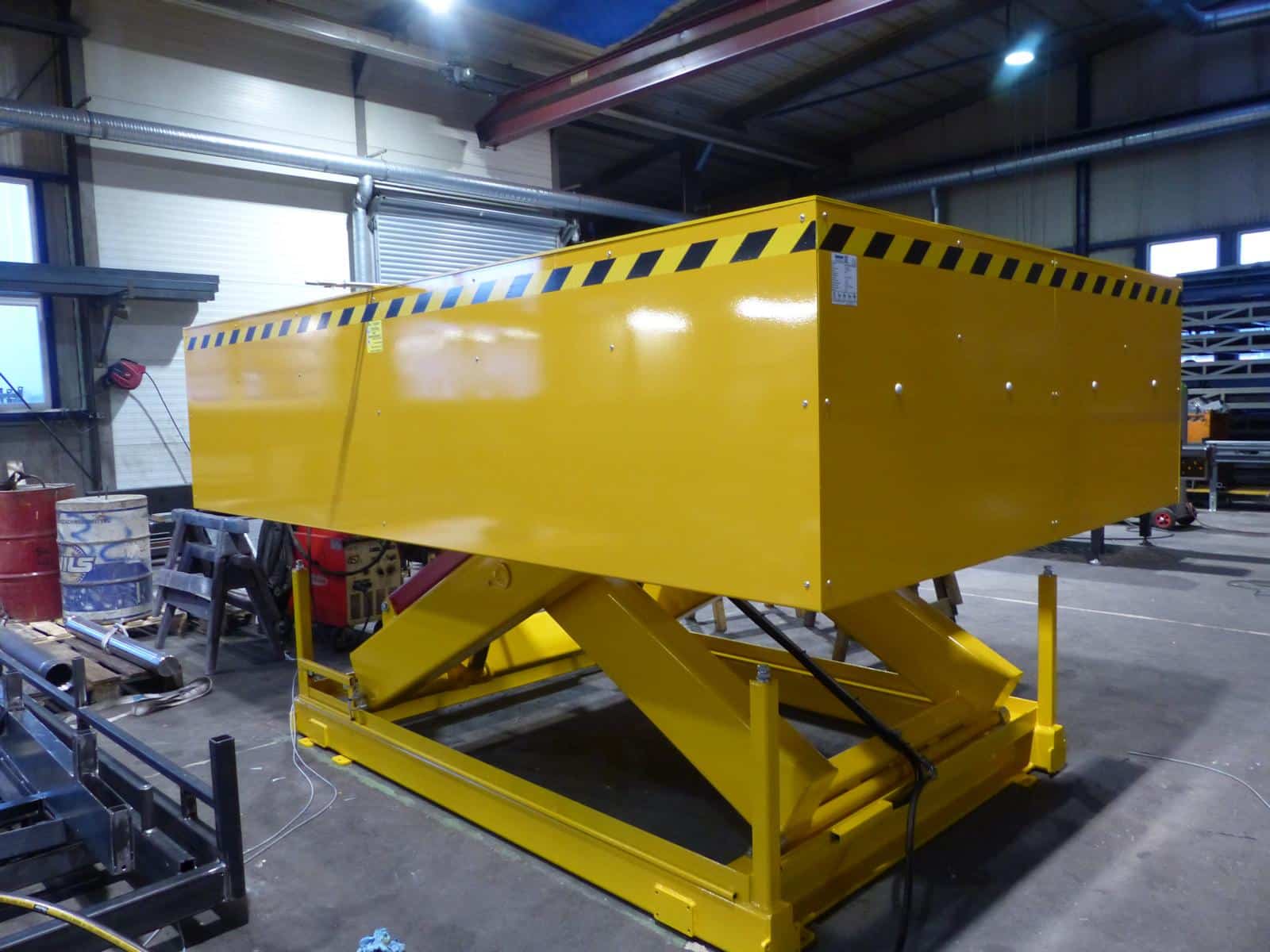
Pit installation with sheet metal skirt instead of pleated bellows
Picture 3: The heavy-duty lifting table during production in an elevated position. The yellow sheet metal cladding surrounds the upper area of the shearing structure.
Another special feature is the installation situation.
The lifting table is installed in a pit. Its lower position is below the surrounding ground level. In the upper position, the platform only extends about 400 mm beyond the edge of the pit.
Despite the large gain in height of 1,000 mm, the visible movement area above the pit remains relatively small.
A special sheet metal apron was designed for this project. Unlike many conventional scissor lift tables, no folding bellows are used here. A circumferential safety contact strip was also omitted in this special version.
The massive sheet metal cladding serves to shield access to the moving parts of the shearing structure and to reduce the risk of pinching during installation in the intended installation area.
The safety concept of the entire system is always crucial. The structural shielding, the pit, accessibility, and customer-side control must be coordinated and evaluated accordingly.
In addition to the sheet metal cladding, the lifting table features maintenance supports, a pressure relief valve and a check valve.
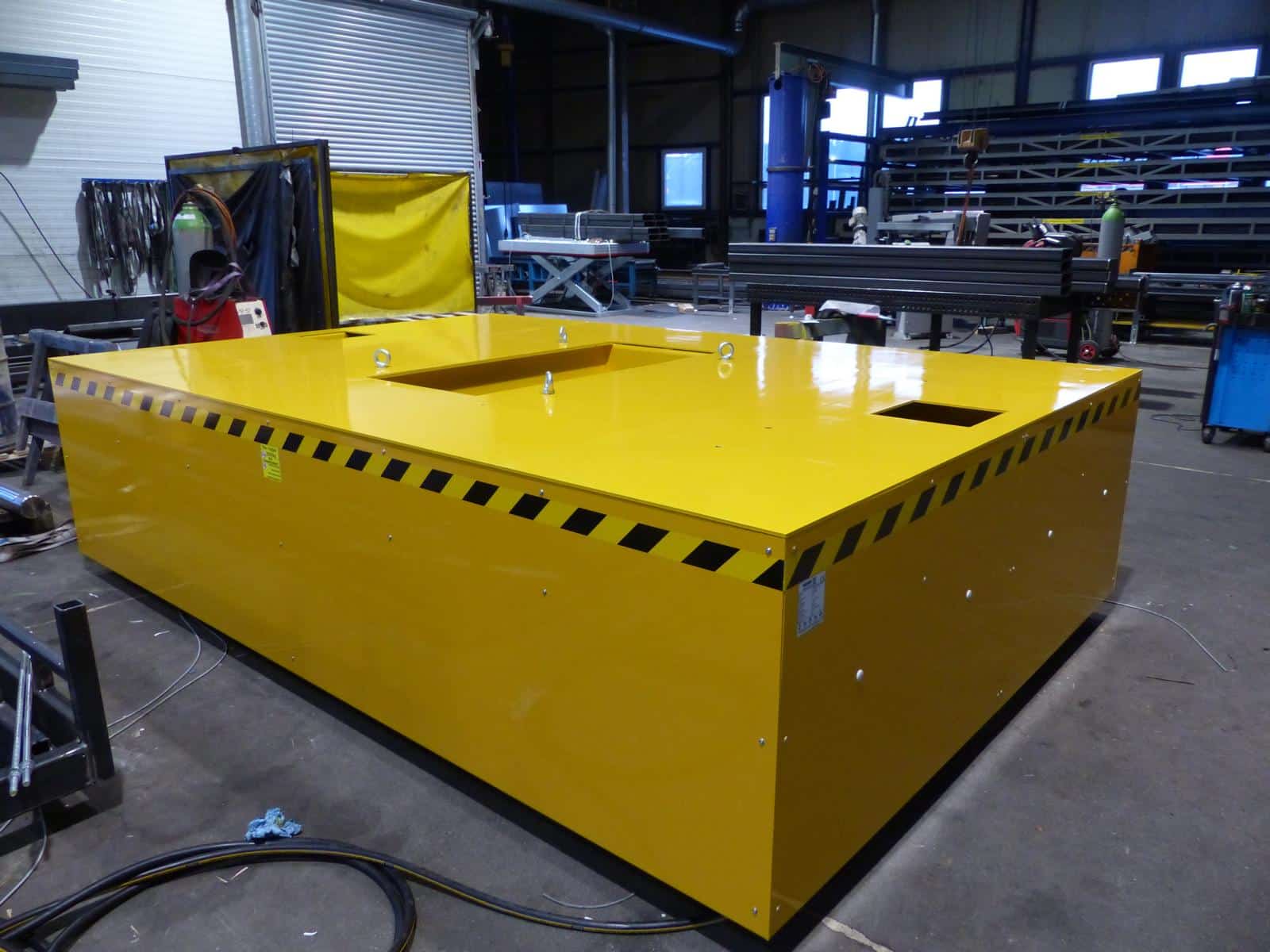
Special design for integration into an existing system
Not every industrial plant requires its own lifting table control system. In this project, the heavy-duty lifting table should be fully integrated into the customer-side control system.
Therefore, it was supplied without a separate control system. The electrical components are wired to a terminal strip. End switches monitor the upper and lower end positions.
The hydraulics have also been adapted to the installation situation. The hydraulic unit is located outside the lifting table and is connected via five-meter-long hydraulic hoses. This allows the unit to be positioned separately from the shearing structure.
Piston cylinders provide the movement of the lifting mechanism. The lifting time is approximately 30 seconds according to the intended design.
Our conclusion: A lifting table with many special requirements
20 tons of lifting capacity alone does not make an exceptional heavy-duty lifting table. In this project, it was the many details that had to be coordinated.
A heavy machine that can be moved on the platform, two defined test heights. Preparation for millimeter-precise positioning, a special sheet metal cladding and integration into an external system control.
To this was added the extremely short production time.
The project demonstrates how flexibly hydraulic scissor lifts can be adapted to industrial processes. Instead of adapting the existing system to a standard scissor lift, the lever solution was tailored to the customer’s requirements.
Do you need a heavy-duty lifting table made to order?
Do you need a heavy-duty lifting table made to order?
Whether 5, 10, 20 tons or more – not every lifting task can be solved with a standard lifting table.
We at maluk We develop individual lever solutions together with our customers for industry, mechanical engineering, plant construction and production. From the initial technical coordination to the finished special design, we take into account the requirements of the respective application area.
Do you have a special lifting task? Talk to our lifting table experts.
FAQ Heavy-duty lifting table
Frequently asked questions about the heavy load lifting table
Yes. However, the design must be explicitly designed for this purpose. If a heavy load moves horizontally on the lifting table platform, its center of gravity changes. This can lead to additional stresses. In this project, the heavy-load lifting table is designed for a load capacity of 20,000 kg, while an 8,000 kg heavy load is transported using customer-side rails in the X and Y directions. The permissible travel ranges and load cases must already be determined during design.
Yes. Heavy-duty lifting tables with very high lifting capacity can also be designed for installation in mines. Particularly important are the mine dimensions, the height of the lifting table, the absorption of forces into the underground and the protection of the movement area. In this project, the lower position is below ground level. In the upper position, the platform protrudes about 400 mm above the mine.
The achievable positioning accuracy depends on the entire drive technology, sensors, and control system. For demanding applications, for example, frequency inverters and distance measurement systems can be used. In the project presented here, the distance is 100 mm. Positioning target ± 3 mm. The lifting table was equipped with a FU-compatible motor and preparation for a cable tension sensor. The actual position control is performed via the customer-side control system.
Whether a version without a safety contact strip is permissible depends on the installation situation and the risk assessment. Alternative technical protective measures can be considered in the respective safety concept. In the case of this heavy-duty lifting table, a sheet metal shield was provided to shield the moving areas. Whether this provides sufficient protection in conjunction with the other measures must be demonstrated for the specific overall system.
The manufacturing time depends on the load capacity, platform dimensions, lifting height, equipment, and the structural complexity. Special-order products usually require individual technical coordination. This project demonstrates that under certain conditions it is possible to complete work significantly faster: the 20-ton heavy-duty lifting table with a 3,700 × 2,500 mm platform was manufactured within six weeks using the express method.