
 DE
DE EN
EN IT
IT SL
SL HU
HU SK
SK CS
CSlifting table for the Marian organ in Cologne Cathedral
Scissor lift table for raising the organ in Cologne Cathedral
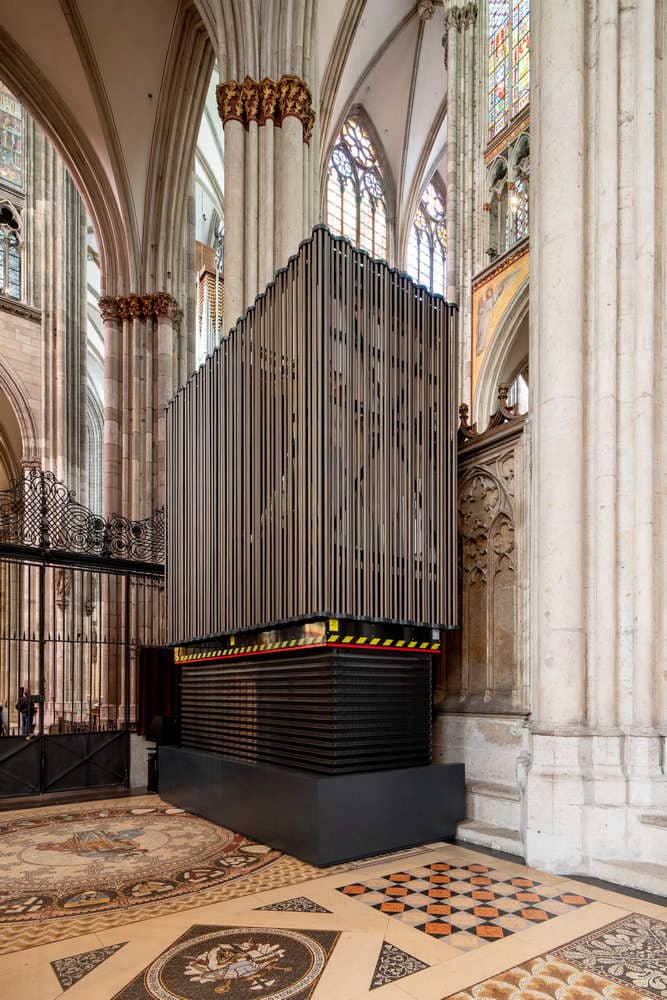
The Scissor lift table in Cologne Cathedral is not an everyday project. For the new Marian organ in Cologne Cathedral we were able to supply the lifting technology with which the entire instrument can be raised.
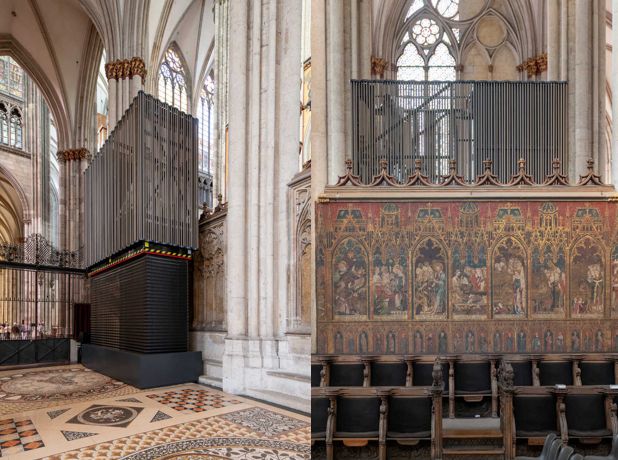
The new organ was by the Johannes Klais Orgelbau GmbH built from Bonn and officially inaugurated on 14 June 2026. The special thing about the construction: the entire organ stands on one supplied by us Scissor lift table. If this is raised, the position of the organ changes and with it the projection of the sound. In the upper position, the sound can be directed specifically via the choir stalls into the inner choir.
What later works at the touch of a button was, however, anything but simple to implement. The project was preceded by a long planning and coordination phase. Listed building conservation, permits, structural analysis, available installation conditions and the visual integration of the technology had to be reconciled with one another.
Lifting technology as part of the organ design
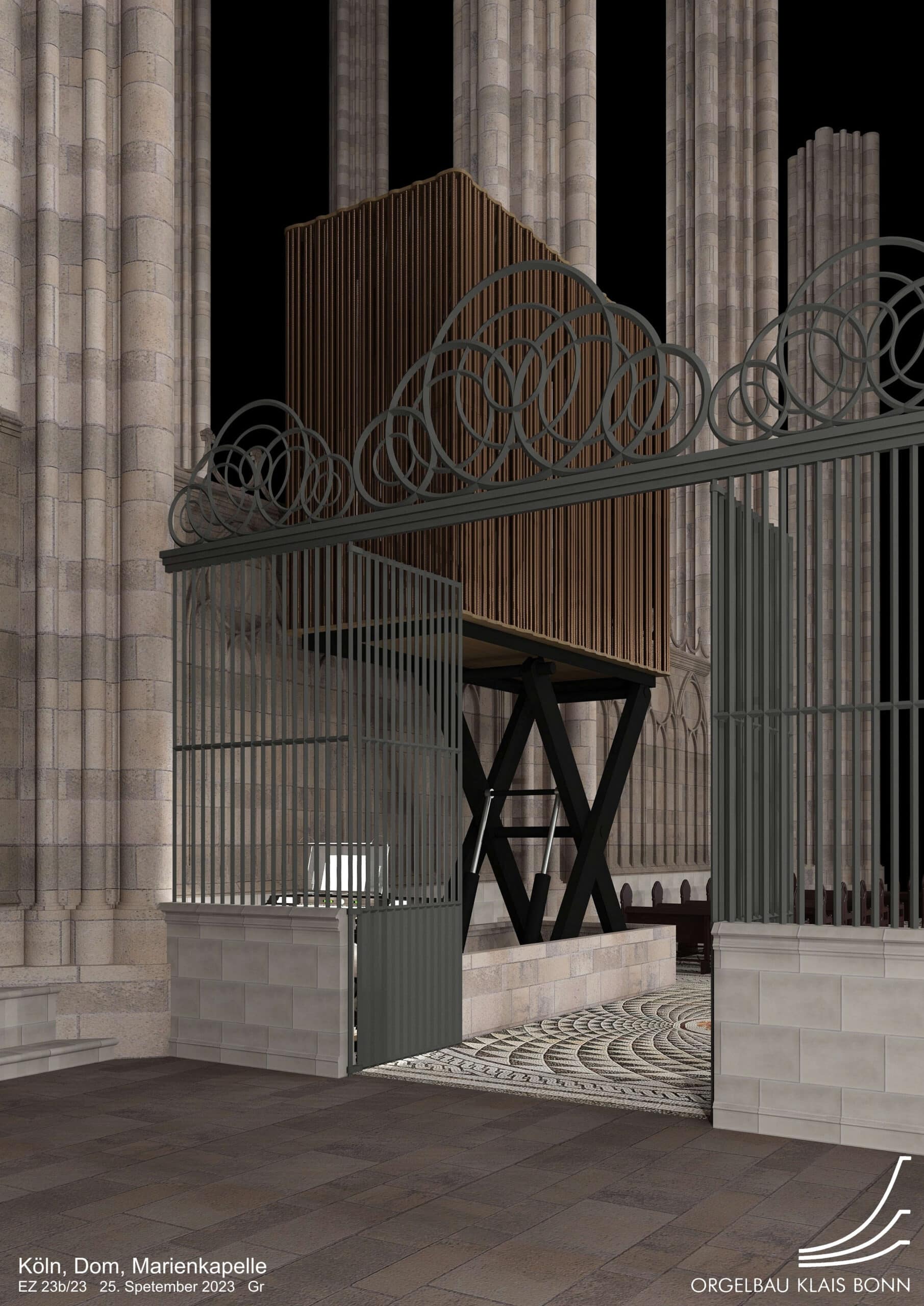
The new St Mary's organ is not simply set up on a platform. The entire organ case is moved vertically by the scissor lift table beneath it.
This makes the lifting platform an essential part of the overall concept: in its lowered position, the organ serves primarily the Marian Chapel. When raised, the sound can spread more towards the inner choir. It is precisely this movable construction that is highlighted by both Cologne Cathedral and the organ builder as a technical feature of the new instrument.
Load capacity
6000 kg
Platform
4210 x 1700 mm
Stroke
2800 mm
Conservation, technology and aesthetics had to work together
In industrial plants, the technical function often comes first. In Cologne Cathedral, additional requirements came into play.
The lifting technology is located in a historically and architecturally particularly sensitive environment. Accordingly, extensive consultations took place regarding historic preservation, approval, installation situation and design.
Even before the installation of the new Mary organ, the existing organ was removed so that the historically valuable choir screen paintings behind it could be restored and conserved. This shows how sensitively interventions in this area of the cathedral had to be handled.
The technical construction had to function reliably, but visually it was not allowed to push itself to the foreground. The lifting table therefore largely disappears beneath the organ case and only becomes visible as a component of the construction when raised.
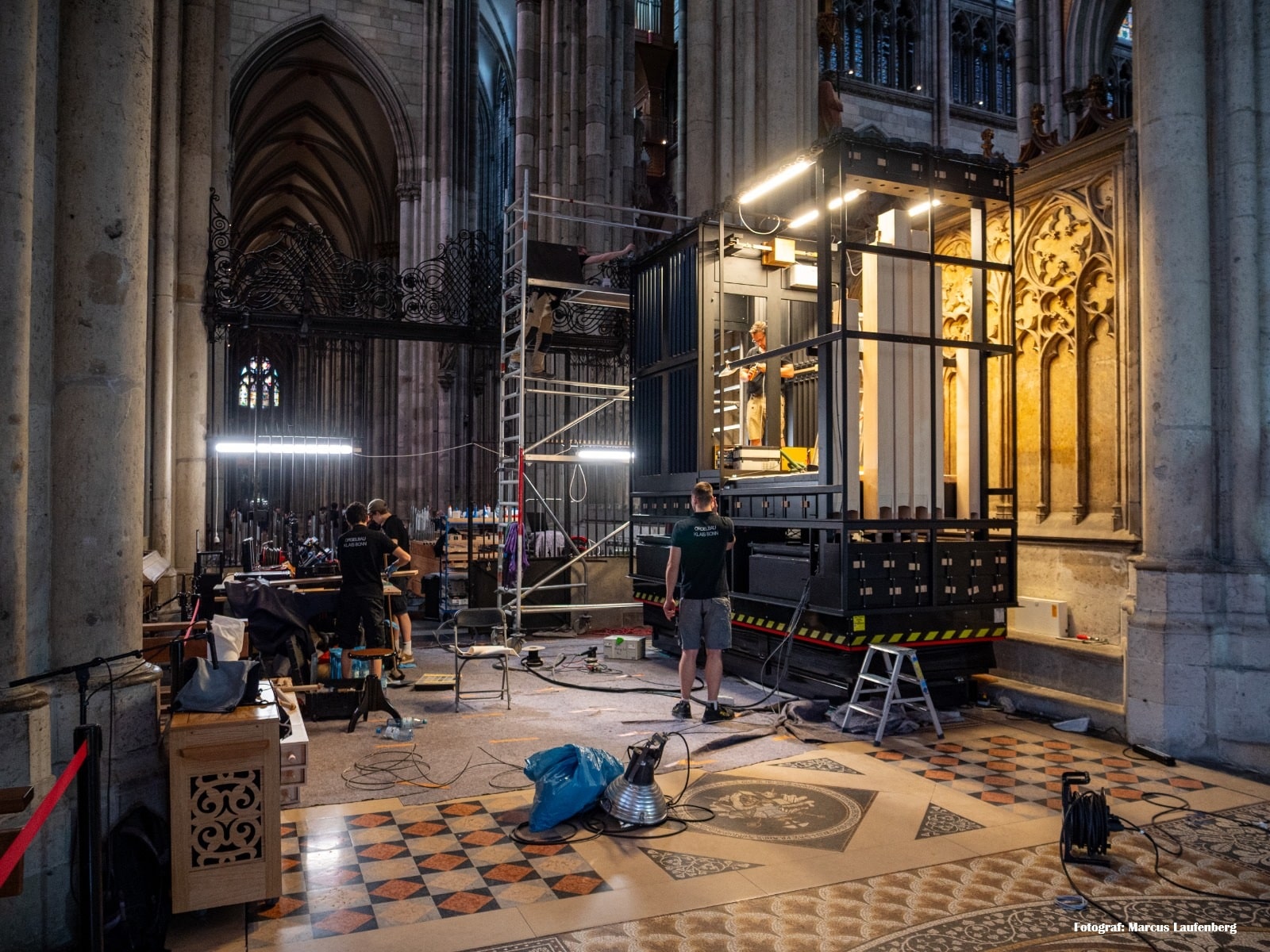
Assembly of a lifting table in Cologne Cathedral
The installation of the lifting table in Cologne Cathedral required special care. In a historical building, insertion and fixing cannot be carried out as they would in an ordinary industrial hall.
Even during the transport of the components to the installation site, special attention had to be paid to the existing floors and the permissible load distribution. At the same time, it was essential to reliably protect historical elements, statues, benches and other fixtures in the immediate vicinity.
Extreme precision was also required when securing the lifting table. Boreholes, support points and the introduction of forces into the existing structure had to be precisely coordinated. Every assembly step was therefore carried out with special care and taking into account the structural and heritage conservation conditions.
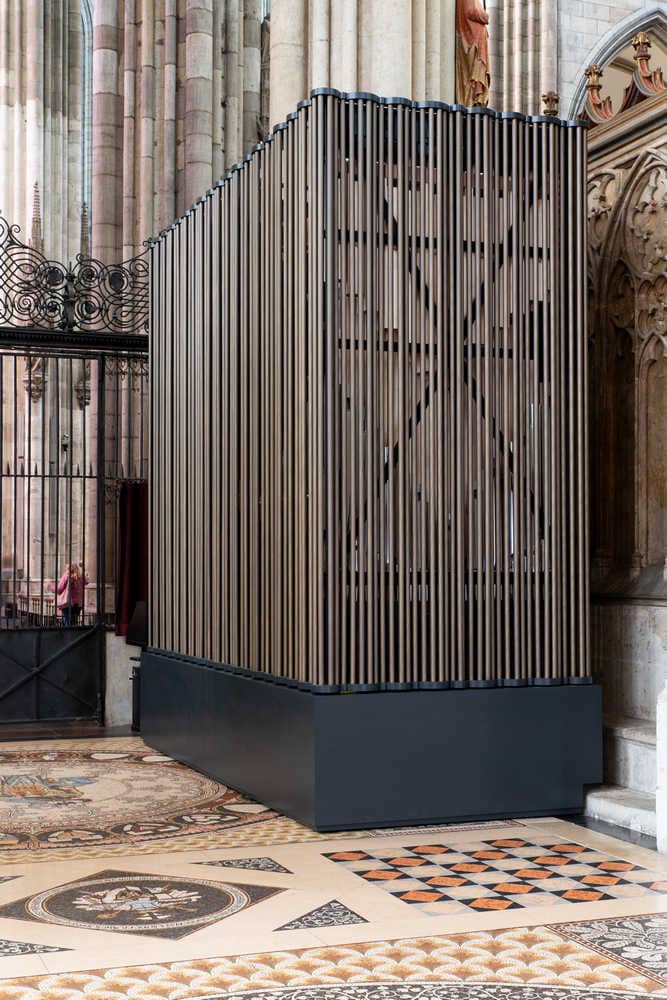
Organ and lifting table lowered
In the lowered basic position, the Scissor lift table almost completely hidden beneath the organ and blends unobtrusively into the overall picture. The technology intentionally recedes into the visual background – what remains visible is primarily the organ itself.
Especially in a listed building such as Cologne Cathedral, this discreet integration was an essential part of the planning. The lifting table forms the technical basis of the design without compromising the architecture and impact of the historic interior.
Organ in the side wing visible via a raised lifting table
In the upper position, the special function of the system becomes clear: the lifting table raises the entire Maria organ to such an extent that it also becomes visible from the adjacent area of the cathedral and the sound can be directed specifically into the inner choir.
The actual lifting table is enclosed by a moving bellows skirt. This protects the moving components against accidental reaching in and at the same time ensures that the lifting mechanism blends aesthetically into the high-end surroundings of Cologne Cathedral, even when extended.
This is how the design combines function, safety and aesthetics – without the technology being more prominent than necessary.
Looking for a custom-made lift table with installation included?
If you have any questions, please contact us immediately Contact on. We are happy!
FAQ about the lift table in Cologne Cathedral
Frequently asked questions about the scissor lift table beneath the Marienorgan in Cologne Cathedral
Lifting changes the position of the entire instrument. This allows the sound to be directed more specifically into the inner choir of Cologne Cathedral. In the lowered position, on the other hand, the focus is on use for the Lady Chapel.
Beneath the entire organ case is a scissor lift table supplied by us. It handles the vertical movement of the entire organ structure.
The steel plate serves to distribute the load over a large area. As a result, the forces from the lifting table and the organ are not introduced into the existing subfloor at a single point, but rather over a larger surface. Especially in the case of a historic building, coordinating the design with the structural engineering is particularly important.
The lift table had to be integrated into a historically particularly sensitive part of the building. Extensive planning and coordination were therefore necessary. In addition to the technical function, the existing structure, the structural engineering and the visual integration also had to be taken into account.
The organ was built by Johannes Klais Orgelbau from Bonn. It has 18 stops. The organ case was designed by the architectural firm Mecanoo from Delft. The scissor lift table underneath, which can be used to raise the entire instrument, originates from us.